
Rent can feel like a completely different reality depending on where you live. The same income that feels stretched in California or New York may go much further in West Virginia, South Dakota, or Iowa. And if you’re renting with bad credit, limited credit, or no credit history at all, the price of rent matters even more.
Why? Because landlords are not only looking at your credit. They may also look at whether your income seems strong enough for the rent, whether you have past rental issues, and whether your application looks stable overall. A lower monthly rent can make that whole picture easier to explain.
For 2026, the rental market is not as overheated as it was a few years ago, but affordability is still a major problem. Apartment List reported that the national median rent reached $1,379 in May 2026, down 1.5% from a year earlier, while still about 20% higher than at the start of 2021. Apartment List also reported a national multifamily vacancy rate of 7.2%, showing more availability than renters saw during the tightest pandemic-era market.
That cooling does not mean renting suddenly feels easy. Harvard’s Joint Center for Housing Studies reported in March 2026 that 22.7 million renter households were cost burdened in 2024, meaning they spent more than 30% of income on rent and utilities. That was 49% of all renters.
So where is rent most affordable in 2026? Here is how every state compares.
How We Ranked the Most Affordable States for Renters
This ranking is based on median monthly rent, with the lowest-rent state ranked No. 1 and the highest-rent state ranked No. 50.
The rent figures come from a 2026 state rent analysis based on HUD’s 2026 50th Percentile Rent Estimates and U.S. Census Bureau data. HUD explains that 50th percentile rent estimates are median rent estimates for Fair Market Rent areas, although HUD notes they are not the same thing as Fair Market Rents. Construction Coverage’s methodology says its state estimates use HUD’s 2026 50th Percentile Rent Estimates and 2024 American Community Survey data, calculating a weighted monthly rent estimate across rental sizes such as studios, one-bedrooms, two-bedrooms, and larger units.
A few important notes before you use this ranking:
- This is a rent price ranking, not a full “best states for renters” ranking.
- It does not include income, tenant protections, transportation costs, utilities, application fees, or local job opportunities.
- Statewide rent numbers can hide huge differences between cities, suburbs, and rural areas.
- A “cheap” state may still feel expensive if local wages are low.
- A more expensive state may be manageable if your income is higher or you have roommates.
A common affordability benchmark is the 30% rule. HUD defines cost burden as monthly housing costs, including utilities, exceeding 30% of monthly income; severe cost burden means housing costs exceed 50% of monthly income.
In plain English: the rent number matters, but your income matters too.
The 10 Most Affordable States for Renters in 2026
The most affordable states for renters are concentrated mostly in Appalachia, the Midwest, the South, and the Great Plains. These states may give renters more room to meet income requirements, save for deposits, and avoid overextending themselves before they even move in.
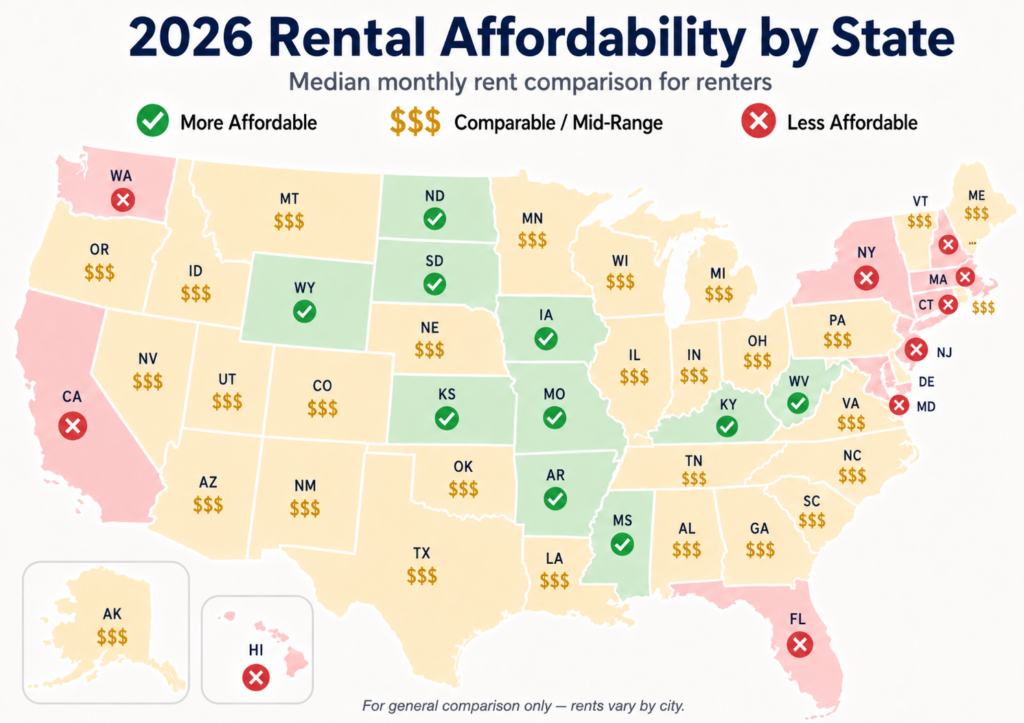
Here are the 10 cheapest states for renters in 2026 based on median monthly rent:
- West Virginia – $1,126
- South Dakota – $1,185
- North Dakota – $1,201
- Mississippi – $1,202
- Iowa – $1,212
- Arkansas – $1,231
- Wyoming – $1,236
- Kentucky – $1,239
- Kansas – $1,247
- Missouri – $1,275
West Virginia takes the No. 1 spot, with a median monthly rent of $1,126. South Dakota, North Dakota, Mississippi, and Iowa round out the top five, all with median rents close to or below $1,212.
For renters with credit challenges, this can matter a lot. A lower rent may help you qualify even if your credit file is thin or imperfect because your income may look stronger compared with the monthly payment. It may also leave more money for move-in costs, utilities, transportation, and debt payments.
That doesn’t mean approval is automatic. You may still need to show proof of income, rental references, a clean explanation of past credit issues, or a co-signer. But a lower rent can make the numbers easier to work with.
Full 50-State Ranking: Cheapest to Most Expensive
Below is the full 2026 ranking of all 50 states, from the lowest median monthly rent to the highest. The state rent figures come from the 2026 rent data table cited above, which found that rents in high-cost coastal states were roughly double those in lower-cost Midwest, South, and Great Plains states.
- West Virginia – $1,126
- South Dakota – $1,185
- North Dakota – $1,201
- Mississippi – $1,202
- Iowa – $1,212
- Arkansas – $1,231
- Wyoming – $1,236
- Kentucky – $1,239
- Kansas – $1,247
- Missouri – $1,275
- Louisiana – $1,278
- Oklahoma – $1,288
- Alabama – $1,290
- Nebraska – $1,295
- Ohio – $1,336
- Wisconsin – $1,342
- Indiana – $1,353
- Michigan – $1,423
- New Mexico – $1,509
- Tennessee – $1,561
- Minnesota – $1,575
- South Carolina – $1,580
- Pennsylvania – $1,619
- North Carolina – $1,621
- Idaho – $1,644
- Montana – $1,713
- Vermont – $1,721
- Texas – $1,722
- Illinois – $1,733
- Maine – $1,734
- Alaska – $1,800
- Georgia – $1,819
- Utah – $1,837
- Rhode Island – $1,867
- Delaware – $1,871
- Oregon – $1,927
- Arizona – $1,986
- Virginia – $2,011
- Nevada – $2,062
- Colorado – $2,076
- Connecticut – $2,127
- New Hampshire – $2,143
- Maryland – $2,195
- Florida – $2,220
- Washington – $2,237
- New Jersey – $2,373
- New York – $2,592
- Massachusetts – $2,595
- Hawaii – $2,869
- California – $2,895
The Most Expensive States for Renters in 2026
At the other end of the list, California is the most expensive state for renters, with a median rent of $2,895. Hawaii follows closely at $2,869. Massachusetts, New York, and New Jersey round out the five most expensive states.
The 10 most expensive states are:
- California: $2,895
- Hawaii: $2,869
- Massachusetts: $2,595
- New York: $2,592
- New Jersey: $2,373
- Washington: $2,237
- Florida: $2,220
- Maryland: $2,195
- New Hampshire: $2,143
- Connecticut: $2,127
According to the same 2026 rent analysis, 13 states now have median market rents above $2,000 per month, up from 12 states the previous year.
For renters, that can change the application process. In a high-rent state, you may face higher income requirements, larger move-in costs, and more competition for units that are actually affordable. If your credit is damaged or limited, the margin for error can be smaller.
That does not mean you should give up. It does mean you should prepare before applying.
What This Means If You Have Bad Credit or No Credit
Rent price is only one part of the application. But it’s a big one.
A landlord may be more willing to look past imperfect credit if the rent is comfortably within your income range, your rental history is strong, and you can show steady employment. On the other hand, even a decent credit profile may not save an application if the rent looks too high compared with your income.
Before applying, try to get your renter packet together. That may include:
- Recent pay stubs or proof of income
- A job offer letter or employment verification
- Bank statements, if you’re comfortable sharing them
- References from past landlords
- Proof of on-time rent payments
- A short letter explaining past credit issues
- A co-signer or guarantor, if available
- Documentation showing that old debts were paid or resolved
It also helps to ask questions before paying an application fee. The FTC recommends asking what information a landlord uses to decide whether to rent to you before paying an application or background check fee. Tenant background checks may include identity details, work and income history, credit account status and payment history, housing court records, criminal history, and other information.
A simple question can save money:
“Before I apply, do you have a minimum credit score, income requirement, or specific screening rule I should know about?”
If the property has a strict credit score cutoff and you know you will not meet it, you may be better off looking for a different landlord instead of paying another nonrefundable fee.
How To Use This Ranking Before You Move
A state ranking is a starting point, not a final answer. Before choosing where to rent, compare the statewide number with your actual target city or neighborhood. Rents in a major metro area can be much higher than the state median, while smaller towns may be lower.
Use this ranking to narrow your search, then look at:
- The average rent in your specific city
- Your monthly income after taxes
- Utility costs
- Transportation costs
- Whether you need a car
- Security deposit and application fees
- Local tenant protections
- Job availability
- Whether landlords commonly require 2.5x or 3x rent in income
For example, Texas ranks in the middle of this list at $1,722, but Austin, Dallas, Houston, San Antonio, and smaller Texas towns can all feel very different. Florida ranks as one of the more expensive states at $2,220, but costs can vary widely between Miami, Orlando, Tampa, Jacksonville, and inland markets.
The real question isn’t just “What state is cheapest?” It is:
“Where can I afford the rent, qualify for the apartment, and still have enough left over to live?”
A Few Smart Moves Before You Apply
If you’re worried about being denied because of credit, slow the process down before you start submitting applications everywhere. Multiple application fees can add up quickly, and repeated denials are frustrating.
Start with these steps:
- Check your credit reports for errors.
- Ask landlords about screening rules before applying.
- Apply for units where the rent fits your income.
- Gather proof that shows you are stable now.
- Be honest, but brief, about past credit problems.
- Keep copies of every application, fee receipt, and denial notice.
- Review any tenant screening report if you’re denied.
The goal is not to pretend credit does not matter. The goal is to make sure credit is not the only thing a landlord sees.
If your credit report has mistakes, old accounts, collections, or confusing negative items, it may be worth dealing with those before your next round of applications. If you have no credit, you may need to show stability in other ways. If you have bad credit, you may need a stronger explanation and better documentation.
The Bottom Line: Affordable States for Renters in 2026
The most affordable state for renters in 2026 is West Virginia, followed by South Dakota, North Dakota, Mississippi, and Iowa. The most expensive states are California, Hawaii, Massachusetts, New York, and New Jersey.
But rent affordability is personal. A lower-rent state can make approval easier, but it does not guarantee it. A higher-rent state can be harder, but strong income, good documentation, and a prepared application can still help.
If you are renting with bad credit, no credit, or a recent denial, the best thing you can do is get organized before you apply. Know what you can afford. Ask about screening requirements. Gather proof of income and rental reliability. And make sure your credit and tenant screening information is accurate.
Renters.help is built for people in that exact situation: trying to understand what may be hurting their applications and what steps to take next.
Not sure what’s holding back your rental application? Renters.help can help you understand what to check before you apply again.