
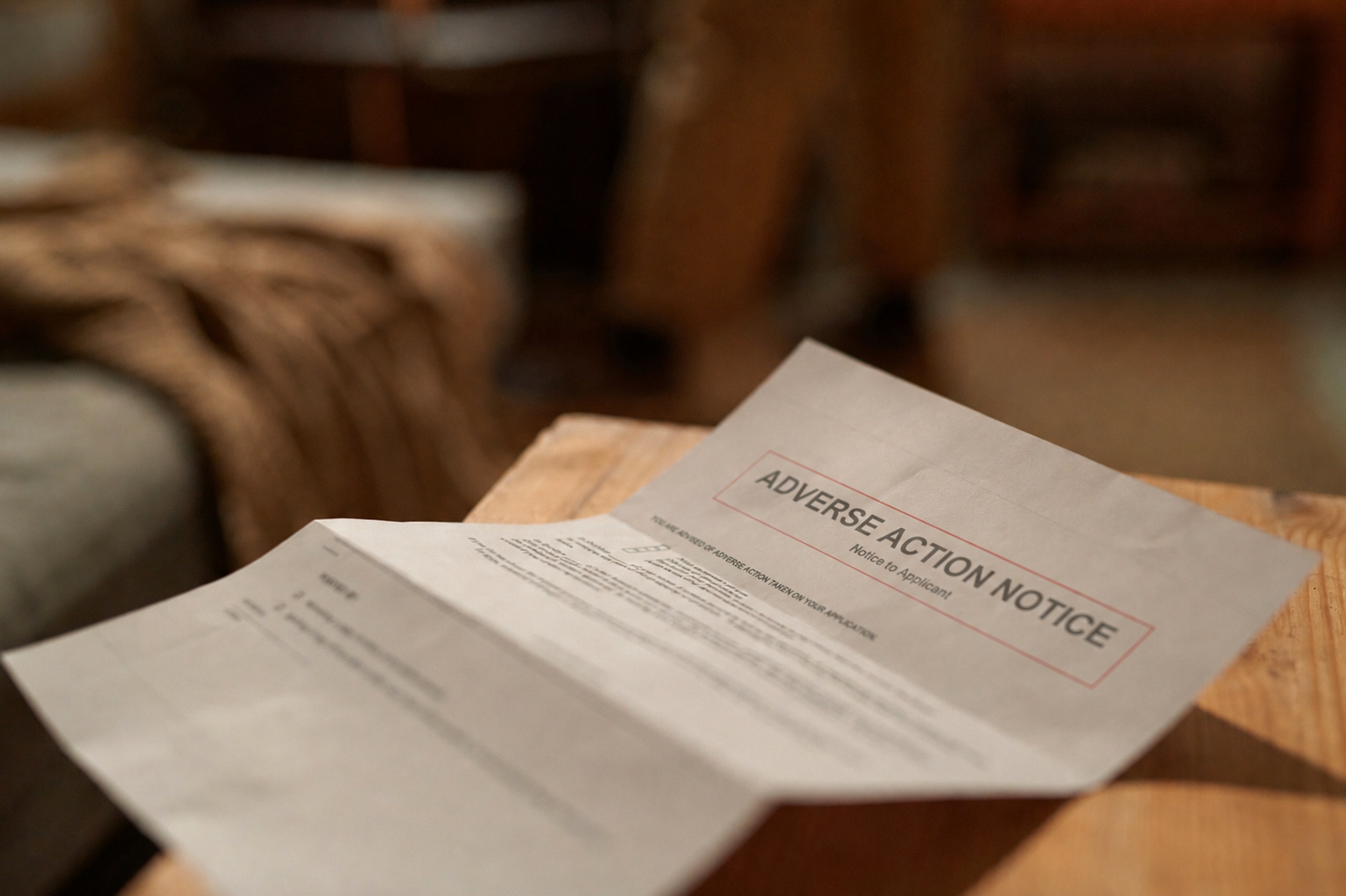
Getting denied for an apartment is frustrating. Getting denied without understanding why is even worse.
Maybe the landlord said your application “didn’t meet screening criteria.” Maybe they told you that you need a co-signer. Maybe they asked for a larger deposit than expected. Or maybe they simply said your application was rejected after running a background check.
If a landlord uses a credit report, tenant screening report, or other consumer report to make a negative decision about your rental application, you may be entitled to something called an adverse action notice.
That sounds formal, but the idea is simple:
An adverse action notice tells you that information in a report affected the landlord’s decision, and it tells you how to request the report and dispute errors.
That matters because rental screening reports can be wrong, incomplete, outdated, or missing important context. If you don’t know what report was used, you may not know what’s hurting your applications.
What Is an Adverse Action Notice?
An adverse action notice is a notice a landlord gives you when they make a negative rental decision because of information in a tenant screening report, credit report, or other consumer report.
The CFPB explains that under federal law, a landlord who denies your rental application because of information in a tenant screening report is required to inform you. That notice is called an adverse action notice. It must provide the name, address, and phone number of the company that provided the report, explain your right to request a free copy of the report within 60 days, and explain your right to dispute inaccurate information.
In plain English, the notice should help you answer three important questions:
- What report was used?
- Who created the report?
- How can I get a copy and challenge mistakes?
That’s important because a denial doesn’t always mean the landlord personally decided you’re a bad tenant. Sometimes a screening report, score, recommendation, credit history item, eviction record, or background check result influenced the decision.
An Adverse Action Isn’t Always a Denial

A lot of renters think an adverse action only means “you were denied.” But it can also mean the landlord offered different terms because of something in a report.
The CFPB says an adverse action can include being denied a rental, being required to have a co-signer, being required to pay a larger deposit, or being charged higher rent than other applicants because of information in a tenant screening report.
The FTC gives similar examples. A landlord may be taking an adverse action if they reject your application, charge more rent, require a co-signer, or demand a larger security deposit because of something in a tenant background check report.
So an adverse action could look like:
- “Your application was denied.”
- “We can approve you, but only with a co-signer.”
- “We can approve you, but you’ll need a larger deposit.”
- “We can approve you, but your rent will be higher.”
- “We can’t move forward because of the screening report.”
- “Your credit, rental history, or background check didn’t meet our criteria.”
That last one can feel vague, but the notice should point you toward the company that provided the report so you can review the information yourself.
What Reports Can Trigger an Adverse Action Notice?
Tenant screening reports are considered consumer reports when they’re prepared by consumer reporting agencies and used for housing decisions. The FTC says these reports may include credit characteristics, rental history, criminal history, rental and eviction history, risk scores, recommendations, or reference checks.
A landlord may use:
- A credit report
- A tenant screening report
- A rental background check
- A criminal background report
- A report from a tenant screening company
- A risk score or recommendation
- A reference checking report
- A report that combines rental history, criminal history, and credit information
If one of these reports influenced the negative decision, the landlord may need to provide an adverse action notice.
The FTC also says the notice is required even if the report wasn’t the main reason for the decision. If information in the consumer report played even a small part in the decision, the landlord must notify the applicant or tenant.
That part matters. A landlord may say, “It was your income and your screening report.” If the report influenced the decision, the notice may still be required.
What Should an Adverse Action Notice Include?
An adverse action notice doesn’t have to be complicated, but it should give you enough information to take the next step.
According to the CFPB, the notice must:
- Be given in writing, orally, or electronically
- Provide the name, address, and phone number of the company that provided the report
- Explain your right to a free copy of the report if you request it within 60 days
- Explain your right to dispute inaccurate information
The FTC’s landlord guidance also says an adverse action notice should include the consumer reporting agency’s name, address, and phone number; a statement that the agency didn’t make the decision and can’t give specific reasons for it; and a notice of the person’s right to dispute the accuracy or completeness of the information and get a free report if requested within 60 days.
In renter-friendly terms, the notice should tell you:
- Which company created the report
- How to contact that company
- That you can request a free copy
- That you have 60 days to request it
- That you can dispute mistakes
- That the screening company didn’t make the landlord’s final decision
If a credit score was used in the decision, the landlord may have additional notice obligations. The FTC says that when a credit score is used to take adverse action, the landlord must provide written or electronic notice that includes the score, score range, source, date created, and key factors that affected the score.
Can the Notice Be Given Verbally?
Yes, an adverse action notice may be given in writing, electronically, or orally. But if the landlord gives it to you verbally, it’s a good idea to ask for a written copy for your records. The FTC specifically recommends asking whether the landlord would be willing to provide a written copy if the notice is given orally.
You can say:
“Can you please send me the adverse action notice in writing, including the name and contact information for the screening company that provided the report?”
That’s a reasonable request. You’re not arguing. You’re trying to get the information you need to review the report.
Written records help if:
- You need to request the report
- You need to dispute an error
- You apply somewhere else
- You need to show what happened later
- The landlord’s explanation changes
When rental decisions are stressful, written documentation keeps things clearer.
Why an Adverse Action Notice Matters
An adverse action notice matters because it gives you a path forward.
Without it, you may be left guessing:
- Was it my credit score?
- Was it a collection account?
- Was it income?
- Was it an eviction filing?
- Was it rental debt?
- Was it something wrong in the report?
- Was I mixed up with someone else?
Tenant screening reports can include a lot of information. The FTC says a tenant background check may include your identity details, work and income history, credit account status and payment history, housing court records, criminal records, missed rent, bankruptcy, lawsuits, and other information. A tenant screening company may also provide a score or recommendation to the landlord that you may not see in the report you receive.
That means the issue may not be obvious from your regular credit report. You may need the specific tenant screening report used by the landlord.
The notice tells you where to start.
What to Do After You Receive an Adverse Action Notice
If you get an adverse action notice, don’t ignore it. The notice may help you understand why you were denied or why the landlord asked for different terms.
Start with these steps:
- Save the notice.
- Write down the date you received it.
- Contact the screening company listed in the notice.
- Request your free copy of the report within 60 days.
- Review the report carefully.
- Look for inaccurate, outdated, duplicated, or incomplete information.
- Dispute anything that’s wrong.
- Save copies of your dispute and supporting documents.
- Ask for written results of the investigation.
The CFPB says if you’re denied because of information in a tenant screening report, you can ask the landlord what information in the report was a problem, ask for a copy of the report or request it from the company the landlord used, review it for inaccurate or outdated information, and dispute errors.
You may not be able to save that specific apartment. But you may be able to fix an issue before it affects the next application.
What to Look for in the Report
Once you get the report, read it slowly. Don’t just look for your credit score and stop.
The CFPB recommends checking rental background reports for issues such as eviction information that doesn’t show the final case status, a single eviction appearing multiple times, sealed or expunged records, outdated eviction information, incorrect criminal records, duplicate criminal records, incorrect debt amounts, and credit history errors.
Look for:
- Names you don’t use
- Addresses where you’ve never lived
- Accounts that don’t belong to you
- Debts that were already paid
- Incorrect balances
- Duplicate records
- Eviction filings without the final outcome
- Dismissed cases that don’t say “dismissed”
- Sealed or expunged records
- Old negative information
- Criminal records that belong to someone else
- Rental debt you don’t recognize
If something looks wrong, gather proof before you dispute it.
Helpful documents may include:
- Court records
- Dismissal orders
- Proof of payment
- Rent receipts
- Bank statements
- Letters from previous landlords
- Settlement agreements
- Identity documents
- Proof that a record was sealed or expunged
- Prior dispute confirmations
The more specific you are, the easier it is for the screening company to investigate.
How to Dispute an Error
If you find inaccurate or outdated information, dispute it with the company that created the report. The CFPB says you can dispute outdated or inaccurate information with the company that created the background check and with the company or person that provided the incorrect information.
For example:
- If a court record is wrong, you may need to contact the court.
- If a collection account is wrong, you may need to contact the collection company.
- If a landlord reported incorrect rental debt, you may need to contact that landlord.
- If the credit portion is wrong, you may need to dispute it with the credit reporting company too.
When disputing, include:
- Your full name
- Your current address
- The report number, if available
- The specific item you’re disputing
- Why it’s wrong, outdated, incomplete, duplicated, or not yours
- Copies of supporting documents
- A request for the item to be corrected or removed
- A request for written results
Tenant background check companies generally must investigate disputes within 30 days, and the FTC says they must tell you the results in writing.
Sample Message to Request the Report
Here’s a simple message you can send to the screening company listed in the notice:
Subject: Request for Free Tenant Screening Report After Adverse Action
Hello,
I recently received an adverse action notice related to a rental application. The notice listed your company as the tenant screening or consumer reporting company that provided the report.
I’m requesting a free copy of the report used in that rental decision. My information is below:
Name: [Your Full Name]
Current Address: [Your Address]
Date of Birth: [Date of Birth]
Last Four Digits of SSN: [Last Four, if requested]
Rental Property Applied For: [Property Address or Name]
Date of Application: [Date]
Please send me a copy of the report and any information I need to dispute inaccurate or incomplete items.
Thank you,
[Your Name]
Keep a copy of the message and any confirmation you receive.
Sample Message to the Landlord
If the landlord denied you but didn’t clearly explain the report information, you can send:
Hi [Landlord or Property Manager Name],
I understand my rental application was not approved. If the decision was based in whole or in part on a tenant screening report, credit report, or other consumer report, can you please send me the adverse action notice and the name, address, and phone number of the company that provided the report?
I’d like to request a copy of the report and review it for accuracy.
Thank you,
[Your Name]
This keeps the tone polite and direct.
What If the Landlord Doesn’t Give You a Notice?
If you believe a landlord used a tenant screening report or credit report to make a negative decision but didn’t provide the required information, you can ask for it in writing.
The CFPB says if you have a problem with credit or consumer reporting, such as tenant screening, you can submit a complaint online or by phone. It also notes that renters may want to contact a lawyer if they believe their rights were violated.
The FTC also says renters can get help if a background check company included errors, didn’t respond to a dispute, didn’t correct false information, or if a landlord didn’t provide required information about the tenant background check company.
You may want to:
- Ask the landlord again in writing.
- Save all emails and messages.
- Contact the tenant screening company if you know who it is.
- Submit a complaint to the CFPB.
- Report the issue to the FTC.
- Contact a local legal aid office.
- Contact a fair housing organization if discrimination may be involved.
You don’t need to accuse the landlord in your first message. Start by asking for the required information clearly.
Does an Adverse Action Notice Mean You Did Something Wrong?
No.
An adverse action notice doesn’t mean you’re a bad tenant, and it doesn’t always mean the information in the report is correct.
It simply means a report affected the decision in a negative way.
Sometimes the issue is accurate, but needs explanation. Sometimes the issue is outdated. Sometimes the report is missing context. Sometimes it belongs to someone else entirely.
That’s why the notice matters. It gives you a chance to see what the landlord saw and take action if something is wrong.
How to Prepare Before the Next Application
After an adverse action notice, it’s tempting to apply somewhere else immediately. Sometimes that’s necessary, especially if you’re in a hurry to move. But if you can, pause long enough to understand what happened.
Before applying again:
- Request the report listed in the notice.
- Review the report for errors.
- Dispute anything inaccurate.
- Check your credit reports too.
- Gather proof of income.
- Gather rental references.
- Prepare a short explanation letter, if needed.
- Ask landlords about screening rules before paying another fee.
- Keep copies of application fees, notices, and reports.
- Apply for units that fit your income and application profile.
If the same report issue keeps showing up, more applications may only lead to more fees and more frustration.
The goal is to apply smarter, not just apply more.
Quick Checklist: What to Do With an Adverse Action Notice
Use this checklist if you receive one:
- Save the notice.
- Note the date you received it.
- Identify the screening or reporting company.
- Request your free copy within 60 days.
- Ask the landlord what information caused concern.
- Review the report carefully.
- Look for wrong, old, duplicate, or incomplete information.
- Gather proof.
- File a written dispute.
- Save copies of everything.
- Follow up if you don’t get a response.
- Use what you learn before applying again.
An adverse action notice may feel like bad news, but it can also give you valuable information.
The Bottom Line
An adverse action notice is a notice you may receive when a landlord makes a negative rental decision because of information in a credit report, tenant screening report, or other consumer report.
It can apply if you’re denied, asked for a co-signer, charged a higher deposit, or offered different rental terms because of something in the report.
The notice should tell you which company provided the report, how to contact that company, that you can request a free copy within 60 days, and that you have the right to dispute inaccurate information.
If you get one, don’t ignore it. Request the report. Read it carefully. Look for errors. Dispute anything that’s wrong. And use what you learn before paying another application fee.
The goal isn’t to become an expert in tenant screening law. The goal is to understand what may be getting in the way of your rental approval and what you can do next.
Renters.help is built for people trying to understand rental denials, credit issues, tenant screening reports, adverse action notices, and the steps to take before the next application.
Received an adverse action notice after applying for an apartment? Renters.help can help you understand what to check before you apply again.