
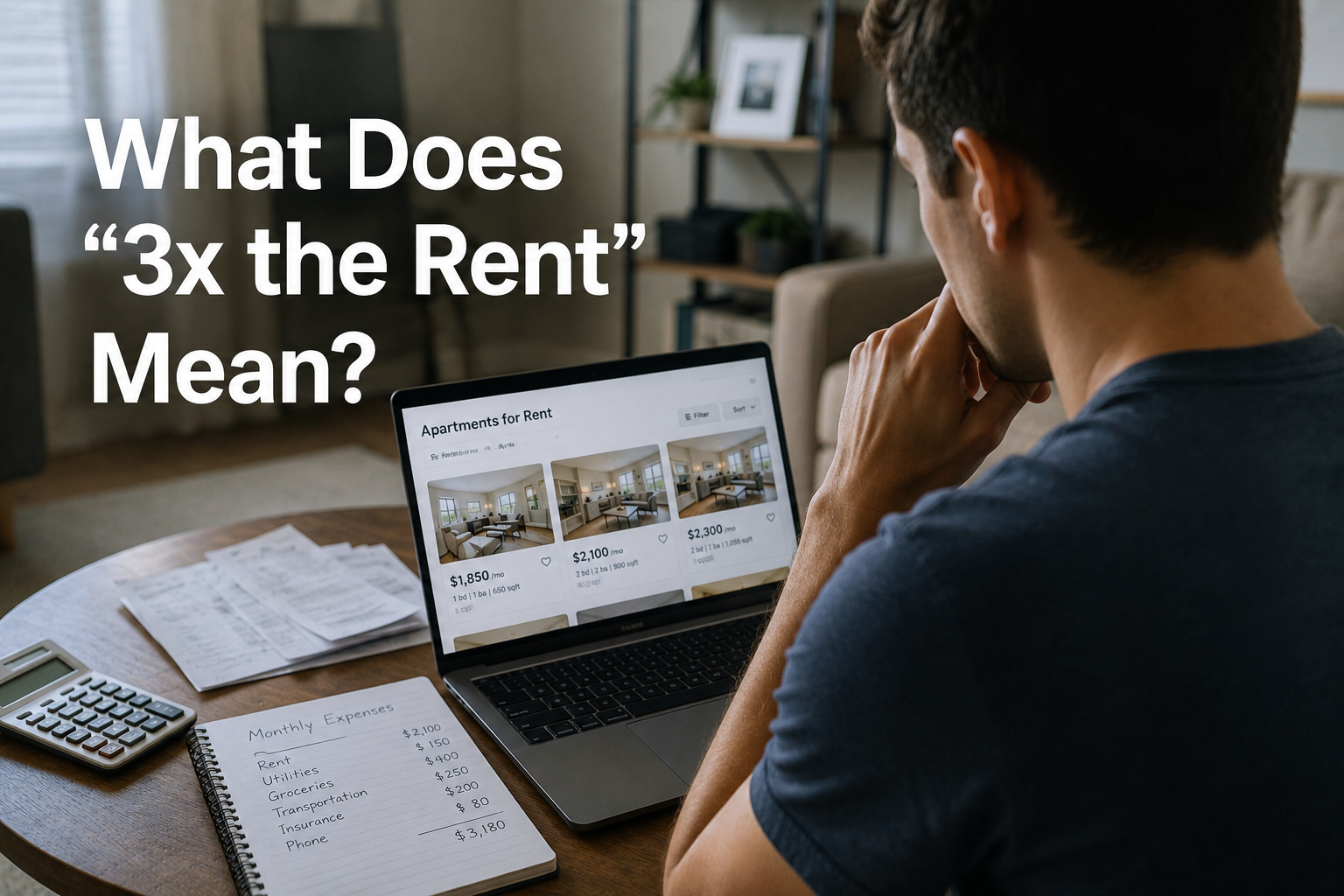
If you’ve been searching for apartments, you’ve probably seen listings that say something like:
“Applicants must earn 3x the rent.”
At first, that sounds simple. But once you start doing the math, questions come up fast.
Do they mean before taxes or after taxes? Can roommates combine income? What if you’re self-employed? What if you’re close, but not quite there? And if the rent technically fits the rule, does that mean you can actually afford it?
The short answer: “3x the rent” usually means your gross monthly income needs to be at least three times the monthly rent.
So if an apartment rents for $1,500 per month, the landlord may want to see monthly income of at least $4,500.
But that’s only the starting point.
A landlord’s income rule helps them decide whether you’re likely to pay rent on time. Your real budget needs to go further. It has to cover rent, utilities, food, transportation, debt payments, savings, and everything else life throws at you.
How to Calculate 3x the Rent
The basic formula is simple:
Monthly rent x 3 = monthly income required
Here are a few examples:
- $1,000 rent x 3 = $3,000 monthly income required
- $1,200 rent x 3 = $3,600 monthly income required
- $1,500 rent x 3 = $4,500 monthly income required
- $1,800 rent x 3 = $5,400 monthly income required
- $2,000 rent x 3 = $6,000 monthly income required
- $2,500 rent x 3 = $7,500 monthly income required
If you want to estimate the annual income needed, multiply the monthly income requirement by 12.
For example:
- $1,500 rent x 3 = $4,500 per month
- $4,500 x 12 = $54,000 per year
So for a $1,500 apartment, a landlord using a 3x rent rule may want annual income around $54,000.
Again, this can vary. Some landlords use 2.5x rent. Some use 3x rent. Some use 3.5x rent or another standard. Some may review income case by case.
That’s why you should always ask before paying an application fee.
Is 3x the Rent Based on Gross or Net Income?
Usually, landlords mean gross income, which is your income before taxes and deductions.
That may include wages, salary, tips, commissions, self-employment income, benefits, retirement income, or other income the landlord accepts.
But your personal budget runs on net income, also called take-home pay. That’s what actually lands in your bank account after taxes, insurance, retirement contributions, and other deductions.
This difference matters.
You may meet the landlord’s income rule on paper but still feel stretched in real life.
For example, if you earn $4,500 per month before taxes, you may qualify for a $1,500 apartment under a 3x rule. But after taxes and deductions, your take-home pay might be much lower. Once you add utilities, transportation, groceries, credit card payments, insurance, and other expenses, the apartment may feel tighter than the approval formula suggests.
A landlord’s rule answers one question:
Do you meet their income requirement?
Your budget answers a different question:
Can you actually live comfortably after paying rent?
You need both answers.
Why Do Landlords Use the 3x Rent Rule?
Landlords use income rules because they want to reduce the risk of missed rent.
Rent is a major monthly obligation. If the rent takes up too much of your income, the landlord may worry that one unexpected expense could make it harder for you to pay on time.
The 3x rule is a quick screening tool. It helps landlords compare rent to income without studying every detail of your budget.
From the landlord’s point of view, it may help answer:
- Does this applicant earn enough for the rent?
- Is rent likely to be manageable?
- Would this applicant be stretched too thin?
- Is additional documentation needed?
- Should a co-signer be required?
From your point of view, it’s a signal too.
If you don’t meet the 3x rule, approval may be harder. If you barely meet it, the apartment may still feel tight. If you comfortably exceed it, income may be one of the stronger parts of your application.
3x the Rent vs. the 30% Rule
The 3x rent rule is closely related to the 30% rule, but they’re not exactly the same.
If you earn three times the rent, the rent is about one-third of your gross income. That’s roughly 33%.

The 30% rule says housing costs are generally considered more affordable when they stay around 30% of income. But there’s an important difference: housing costs usually include more than rent.
Your real housing cost may include:
- Rent
- Electricity
- Gas
- Water
- Trash
- Sewer
- Internet
- Parking
- Pet rent
- Renters insurance
- Storage fees
- Required monthly building fees
So even if the rent alone is close to 30% of your income, your full housing cost may be higher.
That’s why a $1,500 apartment may not really cost $1,500 per month. If utilities, parking, internet, and pet rent add $300, your actual monthly housing cost may be closer to $1,800.
A landlord may qualify you based on rent. Your budget should qualify you based on the full cost.
What If You Don’t Make 3x the Rent?
If you don’t meet the 3x rent requirement, you may still have options. But it depends on the landlord’s rules.
Some landlords have strict requirements. If you don’t meet them, they may deny the application automatically.
Others may review applications case by case.
If you’re close to the requirement, ask whether any of these can help:
- A co-signer or guarantor
- A roommate with qualifying income
- Proof of savings
- Additional income documents
- A job offer letter
- Rental references
- Proof of on-time rent payments
- A lower-rent unit
- A larger deposit, where legally allowed
- Stronger employment verification
For example, if rent is $1,600 and the landlord requires 3x rent, they may want $4,800 per month in income. If you earn $4,500, you’re close but short. A landlord may still consider you if you have savings, strong rental history, or a co-signer.
But don’t assume. Ask first.
Before paying the application fee, say:
“I’m close to the income requirement but may not fully meet 3x the rent. Do you review applications case by case, or would a co-signer or proof of savings help?”
That question can save you money.
Can Roommates Combine Income?
Sometimes.
If you’re applying with a roommate, the landlord may allow you to combine incomes to meet the requirement. But not every landlord handles this the same way.
Some landlords look at total household income. Others require each applicant to meet a certain standard individually. Some may require each roommate to earn 3x their portion of the rent. Others may want the household income to equal 3x the total rent.
For example, let’s say the rent is $2,100.
Under a household-income rule, the landlord may want total monthly income of $6,300.
If you earn $3,200 and your roommate earns $3,400, you may qualify together.
But under an individual-income rule, the landlord might evaluate each person differently.
Before applying with roommates, ask:
- “Can roommates combine income?”
- “Does each applicant need to meet the income requirement individually?”
- “Do you calculate income based on total household income?”
- “What happens if one roommate qualifies and the other doesn’t?”
- “Are all roommates equally responsible for the lease?”
This matters because roommates can help with affordability, but they also create shared responsibility. If one roommate doesn’t pay, the others may still be responsible depending on the lease.
Can a Co-Signer Help If You Don’t Make 3x the Rent?
A co-signer or guarantor may help if your income is slightly below the requirement or if the landlord sees another concern in your application.
But co-signers aren’t always accepted.
Some landlords allow co-signers for students, first-time renters, no-credit applicants, or people slightly short on income. Others don’t allow them at all. Some require the co-signer to earn much more than the renter because the co-signer may already have their own housing costs.
Before asking someone to co-sign, ask the landlord:
- “Do you accept co-signers or guarantors?”
- “Would a co-signer help if I’m below the income requirement?”
- “What income does the co-signer need to show?”
- “Will the co-signer’s credit be checked?”
- “Does the co-signer sign the lease or a separate agreement?”
- “What exactly is the co-signer responsible for?”
- “Can the co-signer be removed later?”
A co-signer may be responsible if you don’t pay rent. That’s a real financial commitment, not just a formality.
What Income Counts Toward 3x the Rent?
This depends on the landlord.
Some landlords count only traditional employment income. Others may count several types of income if you can document them.
Income that may be considered includes:
- Wages
- Salary
- Tips
- Commissions
- Bonuses
- Self-employment income
- Contract work
- Gig income
- Retirement income
- Pension income
- Disability income
- Social Security income
- Child support or alimony, if you choose to disclose and use it
- Housing assistance, depending on the property and applicable rules
- Savings or assets, in some cases
The important thing is documentation.
A landlord may ask for:
- Pay stubs
- W-2s
- Tax returns
- 1099s
- Bank statements
- Benefit letters
- Pension statements
- Job offer letters
- Employment verification
- Profit-and-loss statements
- Client contracts
- Proof of savings
Before applying, ask what income they accept and what documents they require.
What If You’re Self-Employed?
If you’re self-employed, the 3x rent rule can be trickier.
You may earn enough, but your income may not show up in a neat pay stub. It may vary by month, come from multiple clients, or look different on tax returns because of business deductions.
A landlord may ask for extra documents, such as:
- Bank statements
- Tax returns
- 1099 forms
- Paid invoices
- Client contracts
- Profit-and-loss statement
- Business account statements
- Accountant letter
- Proof of savings
Ask whether the landlord uses gross income, net income, average deposits, or another method for self-employed renters.
You can say:
“I’m self-employed, so my income varies by month. What documents do you accept, and do you calculate income based on average monthly deposits, tax returns, or net business income?”
That helps you avoid submitting the wrong documents or paying for an application that won’t be reviewed fairly.
What If You Just Started a New Job?
If you just started a new job, you may not have pay stubs yet.
That can make income verification harder, but not impossible.
You may be able to provide:
- Signed offer letter
- Employment verification letter
- Start date
- Salary or hourly rate
- Expected weekly hours
- Contact information for HR or your manager
- Proof of prior income
- Bank statements
- Proof of savings
Some landlords accept offer letters. Others want actual pay stubs. Some may accept the offer letter with a co-signer or additional savings documentation.
Before applying, ask:
“Do you accept a job offer letter as proof of income, or do you require recent pay stubs?”
That one question can help you avoid wasting the application fee.
How Bad Credit Affects the 3x Rent Rule
Meeting the income requirement helps, but it doesn’t always solve credit concerns.
If you have bad credit, a landlord may still look at your tenant screening report, collections, rental debt, payment history, or eviction-related records.
But strong income can help your application.
If you earn more than 3x the rent and can show stable employment, the landlord may feel more comfortable reviewing your situation. If you also have rental references and proof of on-time payments, that can help even more.
If you have bad credit, try to submit a stronger renter packet with:
- Proof of income
- Employment verification
- Rental references
- Proof of on-time rent payments
- Proof of savings
- Short credit explanation letter
- Documentation showing paid or settled debts
- Co-signer information, if needed
The goal is to show that even if your credit history has problems, the rent fits your current income.
How No Credit Affects the 3x Rent Rule
If you have no credit, income may matter even more.
A landlord may not have much credit history to review, so proof of income, savings, and references can help show stability.
If you meet or exceed the 3x rent rule, that’s useful. But you may still need to provide extra documents if your credit file is thin.
Helpful documents may include:
- Pay stubs
- Employment verification
- Bank statements, if you’re comfortable sharing them
- Proof of savings
- Rental references
- Utility payment history
- Co-signer information, if needed
You can also explain briefly:
“I don’t have much credit history yet, but I have steady income and can provide proof that I meet the income requirement.”
Keep it simple.
What If the Rent Looks Affordable to You, But You Don’t Meet 3x?
This happens a lot.
You may know your budget better than the landlord does. Maybe you don’t have a car payment. Maybe you don’t have debt. Maybe you live simply. Maybe you’re comfortable spending more on rent because the location saves transportation costs.
But the landlord may still use a fixed income rule.
If you don’t meet it, you can ask whether they review applications case by case. You can also offer documents that show why the rent works for you.
That may include:
- Proof of savings
- Low debt obligations
- Proof utilities are included
- Rental references
- Proof of on-time rent payments
- Co-signer information
- A roommate with income
- A lower-rent unit
Still, be honest with yourself. Just because you can make the rent work on paper doesn’t mean it’s safe long term.
If one emergency would make rent late, the apartment may be too expensive.
Don’t Forget Move-In Costs
The 3x rent rule is about monthly income. It doesn’t tell you whether you can afford to move in.
Move-in costs may include:
- Application fee
- Screening fee
- Security deposit
- First month’s rent
- Last month’s rent
- Holding fee
- Administrative fee
- Pet deposit
- Pet rent
- Utility setup fees
- Renters insurance
- Moving truck or movers
Before applying, ask:
“What’s the total amount due before move-in?”
Then compare that number to your savings.
An apartment may meet the monthly income rule but still be difficult if move-in costs wipe out your emergency fund.
Questions to Ask Before Paying an Application Fee
Before you pay, ask about income rules.
Try:
- “Do you require 3x the rent?”
- “Is that based on gross income or take-home pay?”
- “Can roommates combine income?”
- “Can a co-signer help if I’m close?”
- “Do you accept offer letters?”
- “What documents do you need for income verification?”
- “How do you review self-employed income?”
- “Do you count savings or assets?”
- “Are there any automatic denial factors I should know about?”
- “Is the application fee refundable if I don’t meet the income requirement?”
You don’t need to guess. Ask before you spend money.
Sample Message to a Landlord
Here’s a simple message you can send:
Hi [Landlord or Property Manager Name],
I’m interested in applying for [unit/address]. Before I pay the application fee, can you confirm the income requirement? Do applicants need to earn 3x the monthly rent, and is that based on gross income or take-home pay?
I’d also like to know whether roommates can combine income, whether co-signers are accepted, and what documents you need for income verification.
Thank you. I just want to make sure I understand the requirements before applying.
This message is polite, direct, and practical.
Quick 3x Rent Checklist
Before applying, make sure you know:
Monthly rent
Required income multiplier
Monthly income required
Whether the rule uses gross or net income
Whether roommates can combine income
Whether co-signers are allowed
What income documents are required
Whether self-employed income is accepted
Whether job offer letters are accepted
Total move-in cost
Monthly utilities and fees
Whether the rent fits your real budget
If you don’t know these numbers yet, slow down before paying an application fee.
The Bottom Line
“3x the rent” usually means your gross monthly income needs to be at least three times the monthly rent.
If rent is $1,500, the landlord may want to see about $4,500 in monthly income. If rent is $2,000, they may want about $6,000.
But qualifying for an apartment and affording an apartment aren’t always the same thing. The landlord’s formula may use gross income, while your real budget runs on take-home pay. And the rent listed online may not include utilities, parking, pet fees, insurance, or move-in costs.
Before applying, ask how the landlord calculates income, whether roommates can combine income, whether co-signers are accepted, and what documents are required.
The goal isn’t just to meet the 3x rule. It’s to choose a rent amount that fits your life after move-in.
Renters.help is built for people trying to understand what may be getting in the way of rental approval, especially when income requirements, credit, tenant screening, application fees, or denials get confusing.
Not sure whether you meet a landlord’s income requirement? Renters.help can help you understand what to check before you apply.