
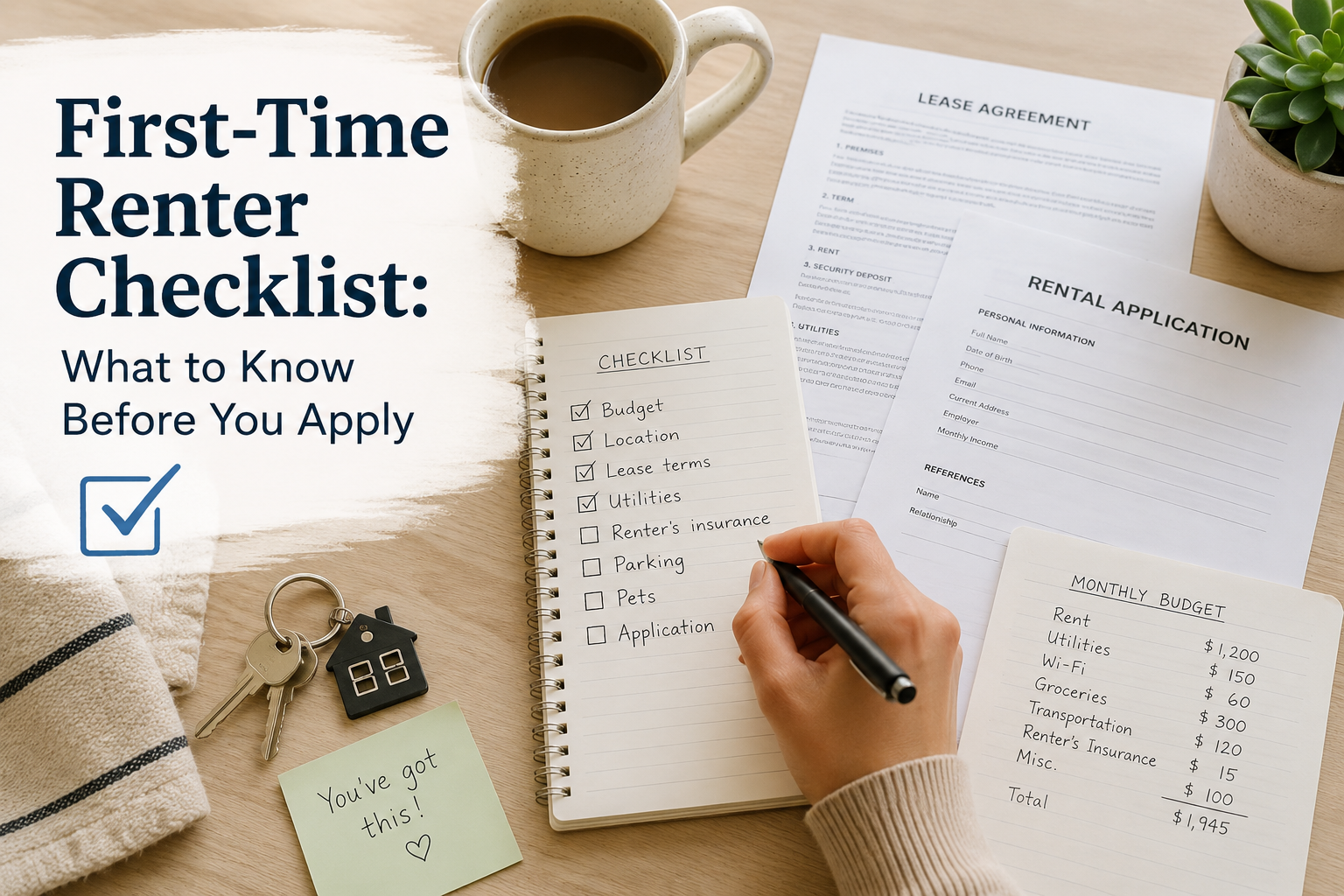
Renting your first apartment is exciting.
It can also feel like everyone expects you to already know how the process works.
What documents do you need? How much income should you have? Will the landlord check your credit? What if you don’t have credit yet? How much money do you need before move-in? What exactly are you supposed to look for in the lease?
If you’ve never rented before, those are completely reasonable questions.
The best thing you can do is get organized before you find an apartment you love. Once you’re emotionally attached to a place, it’s much easier to rush through the application, overlook fees, or agree to a lease you haven’t fully read.
This first-time renter checklist walks you through the process from budgeting and apartment hunting to applications, tenant screening, leases, and move-in day.
Before You Search: Know What Rent You Can Actually Afford
Start with your budget before you start scrolling through listings.
A landlord may use an income requirement, such as 2.5x or 3x the monthly rent, but qualifying for an apartment and comfortably affording it aren’t always the same thing.
Your real budget should include more than rent.
Think about:
- Monthly take-home pay
- Utilities
- Internet
- Phone
- Groceries
- Transportation
- Car payment
- Car insurance
- Student loans
- Credit card payments
- Pet expenses
- Renters insurance
- Savings
- Emergency expenses
If an apartment rents for $1,400 but utilities, parking, internet, and other required fees bring the real monthly cost closer to $1,700, use $1,700 when thinking about affordability.
You also need money before move-in.
Possible upfront costs include:
- Application fee
- Tenant screening fee
- Security deposit
- First month’s rent
- Holding fee
- Administrative fee
- Pet deposit or fee
- Utility deposits
- Moving costs
- Renters insurance
- Basic furniture and household supplies
Don’t use your last dollar just to get the keys. Having some money left for emergencies can make your first few months much less stressful.
Decide What You Actually Need in an Apartment
Before you search, separate your needs from your wants.
Needs might include:
- Rent within your budget
- Safe, functional condition
- Reasonable commute
- Enough bedrooms
- Pet-friendly policy
- Parking
- Accessible entrance
- Laundry access
- Public transportation
- Specific move-in date
Wants might include:
- Pool
- Gym
- Balcony
- New appliances
- Luxury finishes
- Extra bedroom
- Walk-in closet
- Downtown location
There’s nothing wrong with wanting nice features. But if they push the rent beyond what you can comfortably handle, the tradeoff may not be worth it.
A first apartment doesn’t need to be your forever apartment.
Know What Documents You’ll Need
Rental applications can move quickly. Have your documents ready before you apply.
A landlord may ask for:
- Government-issued photo ID
- Recent pay stubs
- Employment verification
- Job offer letter
- Bank statements, if needed
- Rental history
- References
- Social Security number or other identifying information for screening
- Vehicle information
- Pet information
- Co-signer information, if applicable
If you’re self-employed, you may need:
- Tax returns
- 1099 forms
- Bank statements
- Profit-and-loss statement
- Client contracts
- Paid invoices
If you just started a new job, an offer letter may help if you don’t have pay stubs yet.
Keep your renter documents together in one folder or secure digital location. That way, you’re not scrambling when the right apartment appears.
What If You’ve Never Rented Before?
No rental history doesn’t automatically mean you can’t rent.
Everyone has a first apartment.
If you don’t have prior landlord references, strengthen other parts of the application.
You may be able to provide:
- Proof of steady income
- Proof of savings
- Employment verification
- Professional references
- Personal references, if accepted
- Utility payment history
- Co-signer or guarantor information
- A larger renter packet with supporting documents
You can also be upfront:
“This would be my first apartment, so I don’t have prior landlord references yet. I do have steady income and can provide employment verification, savings documentation, and references.”
That’s better than leaving the rental history section blank without explanation.
Check Your Credit Before Applying
Your first landlord may check your credit or use a tenant screening report.
Don’t wait until after a denial to find out what’s on your credit report.
Check for:
- Accounts you don’t recognize
- Late payments
- Collections
- High balances
- Accounts incorrectly marked unpaid
- Duplicate accounts
- Wrong addresses
- Signs of identity theft
- Old information that may need review
Checking your own credit gives you time to understand what a landlord may see.
If something is wrong, dispute it.
If something negative is accurate, you can prepare a short explanation and supporting documents instead of being caught off guard.
What If You Have No Credit?
First-time renters often have little or no credit history.
No credit isn’t the same as bad credit.
Bad credit usually means negative information exists. No credit usually means there isn’t enough history for a strong credit profile.
If you have no credit, a landlord may rely more heavily on:
- Income
- Employment
- Savings
- References
- Co-signer or guarantor
- Other proof that you can handle monthly payments
Before paying an application fee, ask:
“Do you accept applicants who don’t have much credit history?”
Then ask what alternative documents can help.
Ask About Screening Rules Before Paying an Application Fee
This is one of the best habits a first-time renter can learn.

Don’t apply blindly.
Before paying a fee, ask:
- “Do you have a minimum credit score?”
- “What income do you require?”
- “Do you use gross income or take-home pay?”
- “Do you accept applicants with no credit?”
- “Do you allow co-signers?”
- “Do you use a tenant screening company?”
- “Are there any automatic denial factors?”
- “Is the application fee refundable in any situation?”
- “Is this exact unit still available?”
- “Are applications already pending?”
You’re not asking the landlord to guarantee approval. You’re asking whether applying makes sense.
Application fees can add up quickly. A few questions upfront can save you money.
Understand Tenant Screening Reports
A tenant screening report may include more than your credit score.
Depending on the screening company, it may contain information such as:
- Credit history
- Rental history
- Eviction-related records
- Rental debt
- Housing court information
- Background check information
- Identity details
- A screening score or recommendation
This matters because a renter can check their credit report and still be surprised by something in a tenant screening report.
If your application is denied because of screening information, ask what report was used and how you can get a copy.
Review anything used against you for errors.
Tour the Apartment Carefully
Don’t let nice photos do all the decision-making.
When you tour the apartment, actually inspect it.
Check:
- Water pressure
- Hot water
- Faucets
- Toilets
- Appliances
- Windows
- Door locks
- Smoke detectors
- Heating and cooling
- Outlets
- Signs of leaks
- Water stains
- Mold concerns
- Pest signs
- Flooring
- Cell phone reception
- Noise
- Parking
- Laundry
- Building security
Ask what utilities you’ll pay and whether any required monthly fees aren’t included in the advertised rent.
If possible, visit the neighborhood at different times. A block that feels quiet at noon may feel completely different during rush hour or late at night.
Watch for Rental Scams
First-time renters can be attractive targets for scammers because they may not know what the normal process looks like.
Be careful if:
- The rent is much cheaper than similar apartments.
- You can’t tour the property.
- The landlord refuses a live video tour.
- They claim to be out of town.
- They pressure you to send money immediately.
- They ask for gift cards, cryptocurrency, wire transfers, or unusual payment methods.
- They won’t provide a lease.
- They won’t answer basic questions.
- They want money before you verify the property.
- The listing details keep changing.
Verify the rental and the person you’re dealing with before sending sensitive documents or money.
Urgency is not a substitute for verification.
Understand the Security Deposit
Before paying a security deposit, know:
- The amount
- Whether it’s refundable
- What deductions may be made
- When it will be returned
- Where it will be held, if local law requires special handling
- Whether pet deposits are separate
- Whether there are other nonrefundable fees
Security deposit rules vary by state and city.
When you move in, photograph and video the apartment before unpacking. Document existing scratches, stains, holes, damaged blinds, appliance issues, and anything else you don’t want blamed on you later.
Save those files.
Read the Lease Before You Sign
The lease is not just paperwork standing between you and the keys.
It’s the agreement that controls your rental.
Read it.
Pay attention to:
- Monthly rent
- Rent due date
- Lease length
- Late fees
- Security deposit
- Utilities
- Pet rules
- Parking
- Guests
- Roommates
- Smoking
- Maintenance responsibilities
- Entry rules
- Renters insurance
- Renewal
- Early termination
- Subletting
- Move-out notice
- Cleaning expectations
- Fees
- Property rules
If something the landlord promised isn’t in the lease, ask for it to be added in writing.
For example, if you were told parking is included but the lease says nothing about parking, clarify before signing.
Verbal promises can become difficult to prove later.
Ask About the Total Monthly Cost
Advertised rent may not be the full monthly cost.
Ask about:
- Water
- Electricity
- Gas
- Trash
- Sewer
- Internet
- Parking
- Pet rent
- Amenity fees
- Pest control fees
- Package fees
- Renters insurance
- Utility billing fees
You can ask:
“What would I be required to pay every month in addition to the listed rent?”
That question is much more useful than simply asking, “Are utilities included?”
Think Carefully About Roommates
Roommates can make rent much more affordable, but they can also create financial risk.
Before signing together, understand:
- Who pays what
- How utilities are divided
- How deposits are divided
- What happens if someone moves out
- Whether everyone is jointly responsible for rent
- Guest rules
- Cleaning responsibilities
- Pet responsibilities
- How shared purchases are handled
Don’t assume that because your roommate doesn’t pay their half, you only owe your half. Your lease may make all tenants responsible for the full amount.
Read the lease carefully.
It’s also smart to have a simple roommate agreement between yourselves, even if the landlord doesn’t require one.
Know the Pet Policy Before Applying
If you have a pet, confirm the rules before paying a fee.
Ask about:
- Pet types allowed
- Breed restrictions
- Weight limits
- Number of pets
- Pet deposit
- Pet fee
- Monthly pet rent
- Vaccination requirements
- Pet screening
- Insurance requirements
Get pet approval in writing.
Don’t assume “pet-friendly” means every animal is automatically allowed.
Service animals and disability-related assistance animals may involve different fair housing rules than ordinary pets, so those situations should be handled separately.
Understand Renters Insurance
A landlord may require renters insurance.
Even when it isn’t required, renters insurance can be worth considering because the landlord’s insurance generally protects the building, not necessarily your personal belongings.
Depending on the policy, renters insurance may cover things like:
- Personal property
- Theft
- Certain types of damage
- Liability
- Additional living expenses after certain covered losses
Ask whether the landlord requires a specific amount of coverage or needs to be listed as an interested party.
Compare policies and understand what is and isn’t covered.
What Happens If Your Application Is Denied?
A denial can happen even when you think you did everything right.
If you’re denied, ask why.
If a tenant screening report, credit report, or other consumer report affected the decision, ask for the adverse action notice and the screening company’s information.
Then:
- Request the report.
- Review it carefully.
- Check for errors.
- Look for rental debt.
- Check eviction-related information.
- Check whether accounts belong to you.
- Dispute inaccurate information.
- Save copies of everything.
Don’t immediately pay another application fee without understanding what caused the first denial.
Use the information to apply smarter.
Before Move-In Day
Once you’re approved, the work isn’t quite finished.
Before move-in:
- Confirm the amount due.
- Get payment receipts.
- Sign the lease.
- Get a copy of the signed lease.
- Confirm the move-in date.
- Set up utilities.
- Buy renters insurance if required.
- Confirm parking.
- Confirm pet approval.
- Schedule movers.
- Change your address.
- Photograph the unit.
- Complete a move-in inspection.
- Test locks and keys.
- Save landlord contact information.
- Know how to report maintenance issues.
Don’t hand over large amounts of money without documentation.
Keep copies of everything connected to the rental.
Your First-Time Renter Checklist
Before you apply:
- Set a realistic rent budget.
- Estimate utilities and monthly fees.
- Calculate move-in costs.
- Check your credit reports.
- Gather proof of income.
- Prepare identification.
- Gather references.
- Prepare co-signer information if needed.
- Confirm pet rules.
- Ask about income requirements.
- Ask about credit requirements.
- Ask which tenant screening company is used.
- Confirm the unit is still available.
- Verify the listing is legitimate.
Before you sign:
- Read the entire lease.
- Confirm monthly rent.
- Confirm all required fees.
- Understand the security deposit.
- Confirm utilities.
- Confirm parking.
- Confirm pet approval in writing.
- Understand roommate responsibilities.
- Understand lease renewal rules.
- Understand early termination rules.
- Get important promises in writing.
- Keep a copy of the signed lease.
Before you move in:
- Set up utilities.
- Get renters insurance if required.
- Photograph and video the apartment.
- Complete the move-in condition checklist.
- Test locks, appliances, plumbing, and smoke detectors.
- Save payment receipts.
- Save landlord and maintenance contact information.
- Keep all rental documents together.
The Real Deal About a First-Time Renter Checklist
Renting your first apartment can feel complicated, but you don’t need to know everything at once.
Start with the basics.
Know what you can afford. Gather your documents. Check your credit. Ask about screening rules before paying fees. Tour the property carefully. Read the lease. Understand the real monthly cost. Document the apartment before moving in.
And if you’re denied, don’t assume that’s the end of the road. Find out what report was used, check the information, and use what you learn before applying again.
Your first rental application is easier when you walk into it prepared.
Renters.help is built for people trying to understand rental applications, credit, tenant screening, affordability, fees, leases, and the details that can make renting feel confusing.
Getting ready to rent your first apartment? Renters.help can help you understand what to check before you apply, pay fees, or sign your first lease.