

Security deposits can be one of the biggest upfront costs of renting an apartment.
They can also become one of the biggest sources of frustration when it’s time to move out.
How much can your landlord charge? How long do they have to return the money? Can they deduct for cleaning? What counts as normal wear and tear? And what can you do if the deposit never shows up?
The answers depend heavily on where you live.
There isn’t one national security deposit rule that applies to every renter. States set their own limits, deadlines, and procedures, and some cities or counties provide additional renter protections.
That means a renter in California may face very different rules from someone in Texas, Florida, New York, or Alabama.
This Renters.help guide breaks down the basic security deposit limit and general return timeline in all 50 states for 2026, then explains some of the steps renters can take to protect their money before move-in and move-out.
What Is a Security Deposit?
A security deposit is money a landlord holds during your tenancy to protect against certain unpaid obligations or damage allowed under the lease and applicable law.
Depending on where you live, a landlord may be able to use some of the deposit for things like:
- Unpaid rent
- Damage beyond normal wear and tear
- Certain unpaid utilities
- Cleaning required because of tenant-caused conditions
- Other lease-related costs permitted by law
A security deposit generally shouldn’t be treated as an automatic move-out fee.
When a landlord keeps part of the deposit, many states require some type of written explanation or itemized accounting showing what was deducted and why.
The exact rules depend on your state and sometimes your city.
How Much Can a Landlord Charge for a Security Deposit?
Security deposit limits vary significantly across the country.
Some states generally limit deposits to one month’s rent.
Others allow one-and-a-half, two, or even three months’ rent.
A number of states don’t impose a general statewide cap at all.
Even when a state has a limit, exceptions can apply based on factors such as:
- Furnished vs. unfurnished housing
- Pets
- Length of the lease
- Tenant age
- Landlord size
- Special housing arrangements
- Local ordinances
That’s why you shouldn’t automatically assume your security deposit will equal one month’s rent.
Before you apply or sign a lease, ask how much will be required and whether any additional deposits apply.
How Long Does a Landlord Have to Return Your Deposit?
The return deadline is another area where state laws differ.
Some states generally require security deposits to be returned within about two weeks. Others give landlords 21, 30, 45, or 60 days.
The deadline may also depend on circumstances such as:
- Whether the landlord is making deductions
- Whether you provided a forwarding address
- Whether you gave proper move-out notice
- When you surrendered possession
- When the lease officially ended
- Whether damage estimates are still being completed
Because of those differences, the number of days alone doesn’t always tell the full story.
Still, knowing your state’s general timeline gives you a useful starting point.
Security Deposit Laws by State: 2026 Guide
The summaries below focus on the two questions most renters want answered:
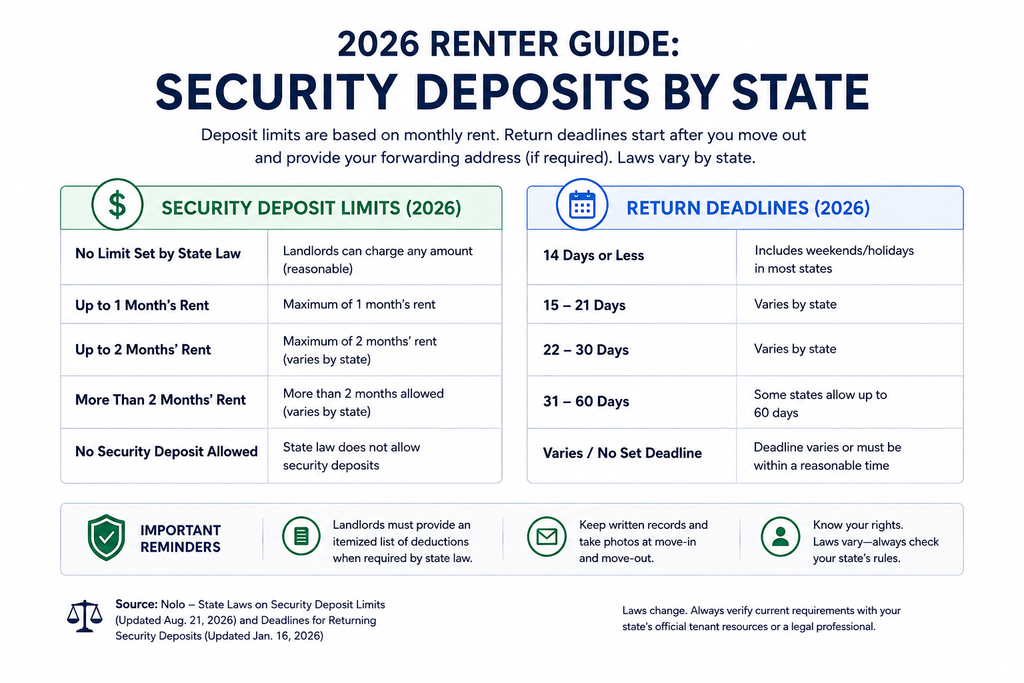
- How much can a landlord generally charge?
- How long does the landlord generally have to return the deposit?
Important: This guide reflects our research as of August 2026 and is provided for general informational purposes only. It isn’t legal advice. Security deposit laws can change, exceptions may apply, and cities or counties may provide additional protections. Always check current state and local requirements or seek qualified legal guidance for your specific situation.
Alabama: Landlords generally can charge up to one month’s rent as a security deposit, although certain additional deposits may be permitted. The general return deadline is 60 days.
Alaska: Security deposits are generally limited to two months’ rent, although an exception can apply when monthly rent exceeds $2,000. Depending on the circumstances and the notice given, the return period may be as short as 14 days or as long as 30 days.
Arizona: Security deposits are generally limited to one-and-a-half months’ rent. The general return period is 14 days, excluding weekends and legal holidays, once the applicable move-out requirements are satisfied.
Arkansas: Security deposits are generally limited to two months’ rent. The general return deadline is 60 days.
California: Security deposits are generally limited to one month’s rent. Certain qualifying small landlords have a limited exception that may allow up to two months’ rent in some situations. Deposits are generally due back within 21 days after move-out.
Colorado: Security deposits are generally limited to two months’ rent. The usual return deadline is 30 days, although a lease may allow a longer period of up to 60 days.
Connecticut: Security deposits are generally limited to two months’ rent. For qualifying renters age 62 or older, the general limit is one month’s rent. The deposit is generally due within 21 days after the tenancy ends or 15 days after the landlord receives a forwarding address, whichever is later.
Delaware: For many leases lasting one year or longer, the security deposit is generally limited to one month’s rent. Exceptions may apply to certain rentals and pet deposits. The general return deadline is 20 days.
Florida: Florida doesn’t impose a general statewide cap on security deposits. If the landlord isn’t making a claim against the deposit, the full amount is generally due within 15 days. If the landlord intends to make deductions, notice generally must be provided within 30 days, with additional procedures applying afterward.
Georgia: Security deposits are generally limited to two months’ rent. The general return deadline is 30 days after the tenancy ends and the renter surrenders the property.
Hawaii: Security deposits are generally limited to one month’s rent, although an additional pet deposit may be allowed in some situations. The general return deadline is 14 days.
Idaho: Idaho doesn’t have a general statewide security deposit cap. Deposits are generally returned within 21 days, although the rental agreement may allow up to 30 days.
Illinois: Illinois doesn’t impose a general statewide cap, although local rules may differ. When deductions for property damage are made, an itemized statement generally must be provided within 30 days. If the required damage documentation isn’t provided, the full deposit is generally due within 45 days.
Indiana: Indiana doesn’t have a general statewide security deposit cap. The general return deadline is 45 days after the renter’s occupancy ends.
Iowa: Security deposits are generally limited to two months’ rent. The usual return deadline is 30 days, and providing a forwarding address is important to the process.
Kansas: Deposits are generally limited to one month’s rent for an unfurnished unit and one-and-a-half months’ rent for a furnished unit. Additional pet deposit rules may apply. The remaining deposit is generally due no later than 30 days after the tenancy ends, with deductions addressed sooner when possible.
Kentucky: Kentucky doesn’t impose a general statewide deposit cap. Its return process is more detailed than a single deadline and can depend on the condition of the property, any disputed deductions, and whether the renter responds to notice about the refund. The process may stretch from roughly 30 to 60 days depending on the circumstances.
Louisiana: Louisiana doesn’t impose a general statewide security deposit cap. The deposit is generally due back within one month after the lease ends.
Maine: Security deposits are generally limited to two months’ rent. For a written lease, the return deadline is generally 30 days. For a tenancy at will, it is generally 21 days.
Maryland: Security deposits are generally limited to one month’s rent, although a limited exception can allow more in certain circumstances. The general return deadline is 45 days.
Massachusetts: Security deposits are generally limited to one month’s rent. The general return deadline is 30 days. Massachusetts also has detailed requirements governing how security deposits are held and documented.
Michigan: Security deposits are generally limited to one-and-a-half months’ rent. The general return or accounting deadline is 30 days, and forwarding-address requirements can be important.
Minnesota: Minnesota doesn’t impose a general statewide security deposit cap. The usual return deadline is 21 days after the renter leaves and the landlord receives a forwarding address. Certain special circumstances can shorten the deadline.
Mississippi: Mississippi doesn’t impose a general statewide cap. The usual return deadline is 45 days after the applicable move-out requirements are satisfied.
Missouri: Security deposits are generally limited to two months’ rent. The general return deadline is 30 days.
Montana: Montana doesn’t impose a general statewide security deposit cap. If there are no deductions, a deposit may be due back in as little as 10 days. When deductions are made, the general deadline can extend to 30 days.
Nebraska: Security deposits are generally limited to one month’s rent when there are no pets. An additional pet deposit may be allowed. The general return deadline is 14 days.
Nevada: Security deposits are generally limited to three months’ rent. The general return deadline is 30 days.
New Hampshire: For covered rentals, security deposits are generally limited to one month’s rent or $100, whichever is greater. The general return deadline is 30 days, although certain housing arrangements can have different rules.
New Jersey: Security deposits are generally limited to one-and-a-half months’ rent, with restrictions on later increases. The general return deadline is 30 days, although much shorter deadlines can apply after certain emergencies or forced displacements.
New Mexico: For leases shorter than one year, security deposits are generally limited to one month’s rent. Different rules can apply to longer leases. The general return deadline is 30 days.
New York: Security deposits are generally limited to one month’s rent. The general return deadline is 14 days after the renter vacates.
North Carolina: The maximum deposit depends on the type of tenancy. It is generally two weeks’ rent for week-to-week rentals, one-and-a-half months’ rent for month-to-month rentals, and two months’ rent for longer terms. Landlords generally must provide the deposit balance and accounting within 30 days, although a final accounting can extend to 60 days when damage costs can’t yet be determined.
North Dakota: Security deposits are generally limited to one month’s rent, although certain exceptions may allow a higher amount. The general return deadline is 30 days.
Ohio: Ohio doesn’t impose a general statewide security deposit cap. The general return deadline is 30 days after the rental agreement ends and the renter gives up possession of the property.
Oklahoma: Oklahoma doesn’t impose a general statewide security deposit cap. The landlord generally has 45 days after the tenancy ends, possession is returned, and the renter makes the required written demand.
Oregon: Oregon doesn’t impose a general statewide security deposit cap. The general return deadline is 31 days.
Pennsylvania: Security deposits are generally limited to two months’ rent during the first year of a tenancy and one month’s rent after that. The general return deadline is 30 days.
Rhode Island: Security deposits are generally limited to one month’s rent. The general return deadline is 20 days after the applicable move-out requirements are satisfied.
South Carolina: South Carolina doesn’t impose a general statewide security deposit cap. The usual return deadline is 30 days, and providing a forwarding address is important to the process.
South Dakota: Security deposits are generally limited to one month’s rent, subject to limited exceptions. Under the state’s 2026 rules, landlords generally have 21 days after the tenancy ends and they receive the renter’s mailing address or delivery instructions to return the deposit or provide the reason money is being withheld.
Tennessee: Tennessee doesn’t impose a general statewide security deposit cap. Landlords generally must follow a written notice and accounting process after the tenancy ends. When deductions or a refund are involved, notice is generally provided within 30 days, and additional rules apply when a renter doesn’t claim the remaining deposit.
Texas: Texas doesn’t impose a general statewide security deposit cap. The general return deadline is 30 days after the renter surrenders the property.
Utah: Utah doesn’t impose a general statewide security deposit cap. The general deadline is 30 days after move-out or 15 days after the renter provides a forwarding address, whichever is later.
Vermont: Vermont doesn’t impose a general statewide security deposit cap. The general return deadline is 14 days, although different rules can apply to certain seasonal rentals that aren’t the renter’s primary residence.
Virginia: Security deposits are generally limited to two months’ rent. The general return deadline is 45 days.
Washington: Washington doesn’t impose a general statewide security deposit cap for standard residential rentals, although the state has extensive rules governing deposits, move-in documentation, installment options, and certain other upfront charges. The general return deadline is 30 days after the tenancy ends and the renter vacates the property.
West Virginia: West Virginia doesn’t impose a general statewide security deposit cap. The deposit generally must be returned within 60 days after the tenancy ends or 45 days after a new renter moves into the property, whichever happens first.
Wisconsin: Wisconsin doesn’t impose a general statewide security deposit cap. The general return deadline is 21 days after the tenancy ends and the renter gives up possession.
Wyoming: Wyoming doesn’t impose a general statewide security deposit cap. The general return period is 30 days after move-out or 15 days after the renter provides a forwarding address, whichever is later. Additional time can be allowed for certain damage-related deductions.
Which States Have Some of the Lowest Security Deposit Caps?
Several states generally limit a standard security deposit to around one month’s rent.
Examples include:
- Alabama
- California
- Hawaii
- Massachusetts
- New York
- Rhode Island
- South Dakota
Other states also use one month as a starting point but allow higher amounts under specific circumstances.
The difference can have a major impact on move-in costs.
For example, if rent is $2,000 per month:
A one-month deposit means $2,000 upfront for the deposit.
A two-month deposit means $4,000.
A three-month deposit means as much as $6,000.
And that’s before adding first month’s rent, application fees, utility setup, movers, pet costs, and other expenses.
This is why renters should ask about the deposit before paying an application fee.
Which States Return Security Deposits the Fastest?
Some states have general return deadlines of around two weeks.
Examples include:
- Arizona
- Hawaii
- Nebraska
- New York
- Vermont
Alaska can also use a 14-day timeline when certain requirements are met.
Montana may require a deposit back in as little as 10 days when there are no deductions.
Many other states fall somewhere in the 20- to 30-day range.
At the longer end, some states allow 45 or 60 days, while others use more complicated processes rather than one simple deadline.
What Can a Landlord Deduct From Your Security Deposit?
Rules vary, but landlords commonly can use a security deposit for certain tenant obligations such as unpaid rent or property damage beyond ordinary wear and tear.
The phrase normal wear and tear is important.
Normal wear and tear generally refers to the ordinary deterioration that happens when someone lives in a home.
Examples might include:
- Minor carpet wear
- Faded paint
- Small marks from normal use
- Aging fixtures
- Light scuffing
Damage generally involves something more than ordinary use.
Examples might include:
- Large holes in walls
- Broken doors
- Major pet damage
- Broken fixtures caused by misuse
- Severe stains
- Damage requiring substantial repair
The exact line between damage and wear can become a disagreement.
That’s why documentation matters.
Take Photos Before You Move In
One of the simplest ways to protect your security deposit is to document the apartment before your belongings arrive.
Photograph or video:
- Walls
- Floors
- Carpet
- Doors
- Windows
- Appliances
- Countertops
- Cabinets
- Bathrooms
- Blinds
- Screens
- Existing stains
- Existing scratches
- Existing holes
- Exterior areas you’re responsible for
Keep the original files.
If your landlord gives you a move-in condition checklist, complete it carefully.
Don’t write “everything looks good” if there’s already a large stain in the bedroom carpet.
Document it.
A year or two later, neither you nor the landlord may remember exactly what the apartment looked like when you arrived.
Photos can.
Document the Property Again Before Moving Out
Before turning in your keys, take another set of photos and videos.
Compare the apartment with your move-in documentation.
Handle reasonable renter responsibilities such as:
- Removing all belongings
- Taking out trash
- Cleaning appliances
- Cleaning bathrooms
- Following written move-out instructions
- Repairing tenant-caused issues where appropriate
- Returning keys
Then document the final condition.
Now, if a deduction appears later, you have a before-and-after record.
Ask About a Pre-Move-Out Inspection
Some states provide specific rights related to pre-move-out inspections, while some landlords may offer them voluntarily.
If one is available, it can be useful.
A landlord may point out issues that could lead to deductions, giving you time to address certain problems before the tenancy ends.
Ask:
“Do you offer a pre-move-out inspection so I can address potential security deposit deductions before I leave?”
Even if your landlord isn’t required to provide one, asking can help clarify expectations.
Always Provide a Forwarding Address
This is easy to forget during a move.
It can also be very important.
Several states connect deposit-return procedures or deadlines to the landlord receiving your forwarding address.
Provide the address in writing.
You might use:
- Tenant portal
- Written move-out notice
- Certified or trackable mail when appropriate
Keep proof of when you provided it.
You want to avoid a situation where the landlord says they didn’t know where to send your money.
What Should a Security Deposit Statement Tell You?
When a landlord keeps part of the deposit, many states require some form of written accounting.
Depending on the state, that may explain:
- What was deducted
- Why it was deducted
- Amount of each deduction
- Repair charges
- Cleaning charges
- Remaining refund
Some states also require receipts, estimates, or additional documentation for certain deductions.
If you receive something vague like:
“Damages: $1,300”
it’s reasonable to ask what those damages were and how the amount was calculated.
Keep:
- Your lease
- Move-in checklist
- Move-in photos
- Move-out photos
- Receipts
- Emails
- Landlord’s deduction statement
- Proof of your forwarding address
Those records can become important if you disagree with the charges.
What If Your Landlord Misses the Return Deadline?
First, confirm that the deadline has actually passed.
Ask:
- When did the tenancy legally end?
- When did you surrender possession?
- Did you provide your forwarding address?
- Is the landlord making deductions?
- Does your state give additional time under certain circumstances?
Then contact the landlord in writing.
A simple message might say:
Hi [Landlord/Property Manager Name],
I moved out of [address] on [date] and provided my forwarding address on [date]. I’m following up regarding my security deposit and any required itemized statement of deductions.
Can you please let me know the status of the deposit and when I should expect the remaining balance and accounting?
My forwarding address is: [address].
Thank you,
[Your Name]
Keep the message calm and factual.
If the landlord still doesn’t respond or you believe the deposit was improperly withheld, review your state and local options.
Some jurisdictions provide additional remedies when landlords fail to comply with security-deposit laws.
Security Deposit Checklist for Renters
Before Moving In
- Confirm the security deposit amount.
- Check your state and local deposit rules.
- Ask whether additional pet deposits apply.
- Get a receipt.
- Read the deposit section of the lease.
- Take photos and videos.
- Complete the move-in condition checklist.
- Save copies of everything.
Before Moving Out
- Review your lease.
- Read the move-out instructions.
- Ask whether a pre-move-out inspection is available.
- Compare the apartment with your move-in photos.
- Clean according to the lease requirements.
- Take final photos and videos.
- Return all keys.
- Document the date you surrendered possession.
- Give the landlord your forwarding address in writing.
After Moving Out
- Mark your state’s general return deadline.
- Watch for the refund and deduction statement.
- Review deductions carefully.
- Compare deductions against your photos.
- Ask about unclear charges.
- Save all correspondence.
- Check state and local remedies if the deadline passes.
Sources & Methodology
This guide was researched and last reviewed in August 2026.
The 50-state summaries were compiled using current state landlord-tenant laws and official state government guidance where available, and cross-checked against current national legal reference materials covering residential security deposits.
Because security-deposit laws change and state statutes often contain exceptions, these summaries intentionally focus on the rules most useful to a typical renter: the general deposit limit and general return timeline.
They are not intended to replace the complete law for a particular property or situation.
Local governments may provide additional protections that aren’t reflected in a statewide summary. Renters dealing with a dispute, unusual lease, subsidized housing, manufactured housing, or another special situation should check current state and local requirements or seek qualified legal guidance.
How Renters Can Protect Their Security Deposit in 2026
The rules may differ from state to state, but the best renter habits are surprisingly consistent.
Know what you’re paying before you move in.
Document the condition of the apartment.
Read your lease.
Save your receipts.
Take move-out photos.
Provide your forwarding address.
And know roughly when your deposit should come back.
A landlord in one state may be limited to one month’s rent and have only 14 days to return the deposit. Somewhere else, there may be no general statewide cap and the return process may take 45 or 60 days.
Knowing the basic rules before a disagreement starts puts you in a much stronger position.
Renters.help is built to help renters understand the costs, rules, applications, screening processes, and financial decisions behind renting before they become expensive surprises.
Moving into or out of an apartment? Use Renters.help to understand security deposits, application fees, rental costs, and the questions worth asking before your money is on the line.