
Credit Score Estimator
Use the Renters.help Credit Score Estimator to answer 6 questions, see your estimated FICO range, and understand what may be helping or hurting your score.
Poor 580
Fair 670
Good 740
Very Good 800+
Exceptional
— Free Tools & Calculators
— Credit Score Estimator
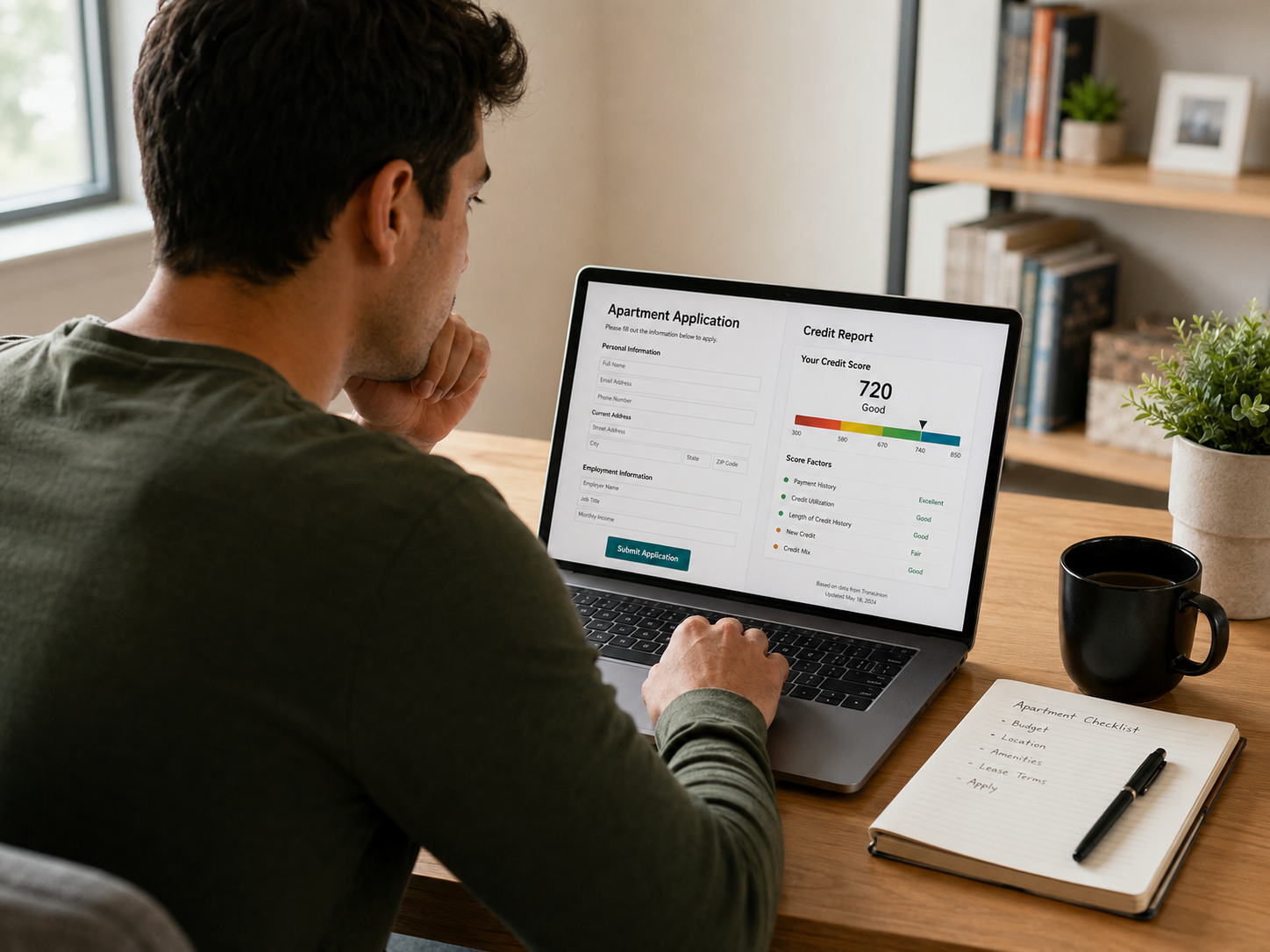
Credit Score Estimator: What’s Your Estimated FICO Range?
Your credit score can affect a lot more than credit cards and loans.
It may affect whether you qualify for an apartment, whether a landlord asks for a co-signer, whether you need a larger deposit, or whether you’re denied after a tenant screening report. It can also affect mortgage rates, personal loan approvals, credit card offers, auto loans, and other financial decisions.
But here’s the frustrating part: a lot of people don’t really know where their score stands until they apply for something.
That’s where the Renters.help Credit Score Estimator can help.
The tool asks 6 simple questions to give you an estimated FICO range and show what may be helping or hurting your score. It’s not an official credit score, and it’s not a guarantee of approval. But it can give you a clearer starting point before you apply for an apartment, credit card, personal loan, or rental screening.
The goal isn’t to scare you. It’s to help you understand what may be affecting your credit so you can take smarter next steps.
What Is a Credit Score Estimator?
A credit score estimator is a tool that gives you a likely credit score range based on the information you provide.
It doesn’t pull your official credit report. It doesn’t replace a real FICO Score from a lender, credit bureau, or credit monitoring provider. And it shouldn’t be treated as a final decision from a landlord or financial company.
Instead, it helps answer a practical question:
“Based on what I know about my credit, what range might my score be in?”
That can be useful if you’re not ready to check a paid score, you’re trying to understand why you keep getting denied, or you want a quick sense of where your credit may stand before applying.
The Renters.help Credit Score Estimator is built to help you:
- Estimate your likely FICO range
- Understand what may be helping your score
- Understand what may be hurting your score
- Spot areas worth checking on your credit report
- Prepare before a rental application
- Think through next steps for rebuilding credit
It’s a starting point, not the final word.
Why Your Credit Score Matters for Renters
A landlord may check your credit when you apply for an apartment. They may also use a tenant screening report, which can include credit information, rental history, eviction-related records, income details, background information, and sometimes a screening score or recommendation.
That means your credit score may not be the only thing a landlord looks at, but it can still matter.
A lower score may make a landlord wonder:
- Have there been recent missed payments?
- Are there unpaid collections?
- Is there rental debt?
- Are balances too high?
- Does the applicant seem stretched financially?
- Would a co-signer be needed?
- Should the application be reviewed more carefully?
A higher score may help, but it doesn’t guarantee approval. Landlords may still look at income, rental history, references, tenant screening results, and whether the rent fits your budget.
That’s why a credit score estimator can be useful before you apply. It helps you understand one important part of the application before a landlord sees it.
What Is an Estimated FICO Range?
A FICO Score is one brand of credit score. Many FICO Scores use a range from 300 to 850, with higher scores generally suggesting lower credit risk.
An estimated FICO range doesn’t give you one exact number. Instead, it places you into a likely range based on your answers.
For example, your result may suggest that your score is likely in a range such as:
- Poor
- Fair
- Good
- Very good
- Excellent
Or it may estimate a numerical range, such as:
- Below 580
- 580–669
- 670–739
- 740–799
- 800+
The exact ranges can vary depending on the scoring model, lender, and credit bureau. That’s why the word “estimated” matters.
You don’t have just one credit score. Different companies may use different scoring models. Your score may also vary depending on which credit bureau’s data is used, when the score is pulled, and which version of the scoring model is applied.
So if the tool estimates one range and another app shows a slightly different score, that doesn’t automatically mean either one is “wrong.” They may be using different data or scoring methods.
How the Credit Score Estimator Works
The Renters.help Credit Score Estimator asks 6 questions designed to reflect the major factors that often affect credit scores.
The tool looks at patterns such as:
- Whether you pay bills on time
- How much debt you carry
- How much available credit you’re using
- How long you’ve had credit accounts
- Whether you’ve applied for new credit recently
- Whether you have collections, charge-offs, bankruptcy, or other serious negative items
- Whether you have a mix of credit accounts
Based on your answers, the tool gives you an estimated FICO range and highlights what may be helping or hurting your score.
That last part is important.
A number by itself isn’t always useful. If your estimated range is lower than expected, you need to know why. Is it late payments? High balances? Collections? Limited credit history? Too many recent applications? No active accounts?
The estimator is designed to point you toward the issues that may matter most.
The 6 Questions: What They’re Really Trying to Understand
The 6 questions in the estimator are meant to quickly understand your credit picture.
They’re not judging you. They’re trying to identify the factors that may be pushing your score up or down.
1. Do you usually pay bills on time?
Payment history is one of the biggest credit score factors. Late payments can hurt, especially if they’re recent or repeated.
If you’ve paid bills on time for years, that may help your estimated range. If you’ve had recent late payments, that may pull the estimate lower.
For renters, this matters because landlords usually want to know whether rent is likely to be paid on time.
2. How much of your available credit are you using?
Credit utilization means how much of your available credit you’re using, especially on credit cards.
For example, if you have a $1,000 credit limit and a $900 balance, you’re using 90% of that available credit. That can be a warning sign to scoring models because it may suggest financial pressure.
Lower balances compared with your limits may help your score. High balances may hurt, even if you’re making payments.
3. How long have you had credit?
Credit history length can matter.
Someone who has managed accounts for many years may look more predictable than someone who just opened their first account. That doesn’t mean new credit users are doing anything wrong. It just means there may be less history to score.
This is why people with no credit or thin credit may have a harder time getting a strong score.
4. Do you have different types of credit?
Credit mix refers to the types of accounts you have. For example, credit cards, auto loans, student loans, mortgages, and personal loans may all be different types of credit.
You don’t need every type of credit to have a good score. And you shouldn’t open accounts you don’t need just to create a mix. But a history of responsibly managing different account types may help.
5. Have you applied for new credit recently?
Recent credit applications can lead to hard inquiries. Too many recent applications may make you look riskier to lenders because it can suggest you’re trying to take on new debt quickly.
One inquiry usually isn’t the end of the world. But several recent applications may hurt more, especially if your file is already thin or your score is already low.
If you’re apartment hunting, it’s also smart to ask whether a landlord’s credit check is a soft inquiry or hard inquiry before applying.
6. Do you have collections, charge-offs, bankruptcy, or other serious negative items?
Serious negative items can weigh heavily on your score.
These may include:
- Collections
- Charge-offs
- Bankruptcy
- Foreclosure
- Repossession
- Accounts currently past due
- Rental debt
- Utility collections
- Settled accounts
- Recent severe late payments
Not all negative items are equal. A small old paid collection may be different from recent unpaid rental debt. A bankruptcy from several years ago may be different from several accounts that are currently past due.
But these items are important to understand because they may affect both credit approval and rental screening.
What Can Help Your Estimated Score?
Your estimated score may be helped by:
- On-time payment history
- Low credit card balances
- Older credit accounts
- Few recent hard inquiries
- No collections or serious negative items
- Paid or resolved accounts
- A mix of responsibly managed credit
- Credit reports without major errors
- Active accounts in good standing
If your tool result shows several positive factors, that may mean your credit is stronger than you expected.
But don’t stop there. If you’re applying for an apartment, also think about income, rental history, proof of savings, tenant screening reports, and any rental debt that may not be obvious from your score alone.
What Can Hurt Your Estimated Score?
Your estimated score may be hurt by:
- Missed payments
- Recent late payments
- High credit card balances
- Maxed-out cards
- Collections
- Charge-offs
- Bankruptcy
- Too many recent credit applications
- Very short credit history
- No active credit accounts
- Accounts currently past due
- Errors on your credit report
- Rental debt or utility collections
The helpful part is that once you know what may be hurting your score, you can decide what to check first.
For example:
- If high balances are the problem, lowering balances may help over time.
- If late payments are the problem, focus on keeping current accounts on time.
- If collections are the problem, review whether they’re accurate, paid, disputed, or outdated.
- If no credit is the problem, you may need to build positive history carefully.
- If errors are the problem, dispute them with supporting documents.
The tool helps you move from “my credit is bad” to “here’s what may be pulling it down.”
Why the Estimator Gives a Range, Not an Exact Score
A credit score estimator can’t give you an exact official score because it isn’t pulling the full credit data used by a scoring model.
A real credit score may depend on:
- Which credit bureau’s report is used
- Which scoring model is used
- Which version of that model is used
- When your balances were last updated
- Whether a creditor recently reported new information
- Whether collections or disputes are showing
- Whether your file has enough information to score
That’s why the Renters.help tool gives an estimated range.
A range is more honest and useful than pretending a quick quiz can produce the exact same number a lender or landlord may see.
Use the result as guidance. Then check your actual credit reports and, when needed, your official scores.
Credit Score vs. Credit Report
Your credit score is the number. Your credit report is the detailed record behind the number.
The report may show:
- Accounts
- Balances
- Payment history
- Late payments
- Collections
- Charge-offs
- Credit inquiries
- Bankruptcies
- Personal information
- Account status
- Credit limits
If your estimated score is lower than expected, your credit report is where you look for answers.
The estimator may tell you that collections, high balances, or late payments are likely hurting you. Your credit report can help you see which accounts are involved.
Before applying for an apartment, it’s smart to review your credit reports and look for errors, outdated information, duplicate accounts, or accounts that don’t belong to you.
What If Your Estimated Score Is Lower Than Expected?
First, don’t panic.
An estimated range is not a final judgment. It’s a signal.
If the result is lower than expected, take a closer look at what the tool says may be hurting you.
Then check your credit reports for:
- Late payments
- Collections
- High balances
- Accounts you don’t recognize
- Duplicate accounts
- Old information
- Incorrect balances
- Accounts marked unpaid that were paid
- Signs of identity theft
- Rental debt
- Utility collections
If something is wrong, dispute it.
If the negative information is accurate, focus on what you can do next. That may mean paying current bills on time, lowering balances, bringing past-due accounts current, documenting paid accounts, or building new positive history slowly.
You may not fix everything overnight, but you can stop guessing.
What If Your Estimated Score Is Higher Than Expected?
That can be encouraging.
But don’t assume a higher estimated score guarantees approval for an apartment, loan, or credit card.
A landlord may still review:
- Income
- Employment history
- Rental history
- Tenant screening report
- Eviction-related records
- Rental debt
- Criminal background information
- References
- Whether the rent fits your budget
A higher credit score can help, but it’s not the whole application.
If the tool suggests your score is in a stronger range, use that as motivation to keep your credit stable. Keep paying on time, avoid maxing out cards, limit unnecessary applications, and check your reports before major applications.
How This Helps Before Applying for an Apartment
If you’re applying for an apartment, the estimator can help you prepare.
For example, if the tool suggests your score may be low because of collections, you can review those collections before applying. If it suggests high balances are hurting you, you may decide to pay down a card before submitting applications. If it suggests limited credit history, you may prepare proof of income, savings, and references.
Your estimated score can help you decide whether to:
- Ask about minimum credit score requirements
- Look for landlords with flexible screening
- Prepare a credit explanation letter
- Gather proof of income
- Gather rental references
- Ask whether a co-signer would help
- Review tenant screening reports after denials
- Dispute errors before applying
- Avoid paying fees for bad-fit applications
The estimator doesn’t approve or deny you. It helps you apply with more information.
Credit Score Estimator vs. Tenant Screening
Credit scores and tenant screening reports are related, but they’re not the same thing.
A credit score estimates credit risk based on credit report data. A tenant screening report may include credit information, rental history, eviction-related records, income details, background information, and a screening recommendation.
That means your estimated credit score may look okay, but a tenant screening report could still create a problem.
For example, a tenant screening report may show:
- Rental debt
- Eviction filing
- Housing court record
- Missed rent
- Identity mismatch
- Background check information
- A landlord reference issue
That’s why renters should think about both credit and tenant screening.
The Credit Score Estimator helps with one important piece of the puzzle. It doesn’t replace reviewing tenant screening reports, rental history, or adverse action notices.
Be Careful With Credit Repair Promises
If your estimated score is lower than you hoped, you may be tempted by companies promising fast credit repair, guaranteed score boosts, or instant deletion of negative accounts.
Be careful.
No one can legally remove accurate and current negative information from your credit report just because you want it gone. Legitimate credit help usually focuses on reviewing your reports, identifying inaccurate or incomplete information, disputing errors, and helping you understand your next steps.
That doesn’t mean you’re stuck forever. Negative information can lose impact over time, and errors can be disputed. But real credit improvement usually takes consistency.
A safer plan usually includes:
- Paying current bills on time
- Lowering credit card balances
- Avoiding unnecessary new applications
- Bringing past-due accounts current when possible
- Reviewing reports for errors
- Disputing inaccurate information
- Keeping proof of paid or settled accounts
- Building positive history over time
The estimator can help you see where to start.
Questions the Estimator Can Help You Answer
The Renters.help Credit Score Estimator can help you think through questions like:
- What’s my likely FICO range?
- Is my payment history helping or hurting me?
- Are high balances hurting my score?
- Is my credit history too short?
- Are recent applications a problem?
- Are collections or serious negative items pulling me down?
- What should I check on my credit report?
- What should I fix before applying for an apartment?
- Should I prepare a credit explanation letter?
- Should I ask about screening requirements before paying a fee?
The result should give you direction, not confusion.
What to Do After You Get Your Estimate
After using the estimator, take the next step based on your result.
If your estimated range is low:
- Check your credit reports.
- Look for errors.
- Review collections and late payments.
- Gather proof for anything paid or disputed.
- Avoid applying blindly.
- Ask landlords about screening criteria before paying fees.
If your estimated range is fair:
- Look for the factors holding it back.
- Pay attention to balances, missed payments, and collections.
- Prepare a stronger renter packet.
- Ask whether landlords review applications case by case.
If your estimated range is good or higher:
- Keep accounts current.
- Avoid unnecessary new applications before major decisions.
- Check for report errors anyway.
- Remember that tenant screening may include more than credit.
The estimate is most useful when you act on it.
Quick Checklist Before Using the Credit Score Estimator
Before you start, think about:
- Whether you’ve missed payments recently
- How much credit card debt you have
- How much available credit you’re using
- How long you’ve had credit accounts
- Whether you’ve applied for new credit recently
- Whether you have collections or charge-offs
- Whether you’ve had bankruptcy, foreclosure, or repossession
- Whether any accounts are currently past due
- Whether you’ve checked your credit reports for errors
Answer honestly. The tool isn’t there to judge you. It’s there to help you understand your starting point.
The Bottom Line
The Renters.help Credit Score Estimator helps you answer 6 questions to get an estimated FICO range and see what may be helping or hurting your score.
It’s not an official credit score. It won’t replace a lender’s score, a landlord’s screening process, or your full credit reports. But it can give you a useful estimate and help you understand which credit factors may deserve attention first.
That can be especially helpful before applying for an apartment, credit card, personal loan, or mortgage.
If your estimate is lower than expected, don’t panic. Check your reports, look for errors, gather documents, and focus on the factors that may be pulling your score down.
If your estimate is stronger than expected, keep protecting it.
The goal isn’t just to know a number. It’s to understand what’s behind the number so you can make smarter decisions.
Renters.help is built for people trying to understand what may be getting in the way of rental approval, especially when credit scores, credit reports, tenant screening, collections, or denials get confusing.
Use the Renters.help Credit Score Estimator to answer 6 questions, see your estimated FICO range, and understand what may be helping or hurting your score.